A Ruthless Blueprint
You know who made reversed cards popular in tarot?
Jean-Baptiste Alliette, better known as Etteilla.
Petit Etteilla is his first blueprint.
Maybe it takes after its designer, the one scorned for being too worldly.
Petit Etteilla isn't here to comfort you with gentle words; it lays reality bare, without mercy.
How money holds you back, what's being said behind your back, what pushed someone that far... it shows all of it, plainly.
Sometimes it can feel cruel.
On a day when the words you least wanted to hear land like a blade... yeah, it can.
Deck Structure
32 Piquet Cards + 1 Etteilla Card
Petit Etteilla is based on a 32-card piquet deck. A piquet deck has four suits: Diamonds, Hearts, Spades and Clubs. Each suit has eight ranks: King, Queen, Jack, Ace, 10, 9, 8 and 7.
Petit Etteilla adds one special card that does not belong to the piquet deck: the Etteilla card. That gives the deck 33 cards in total.
Special card: 1 Etteilla card
Total: 33 cards
Card Numbers Stop at 30
The deck has 33 cards, but the card numbers only run from 1 to 30. Three cards have no number: ♥A, ♠A and ♠9.
Planetary Cards
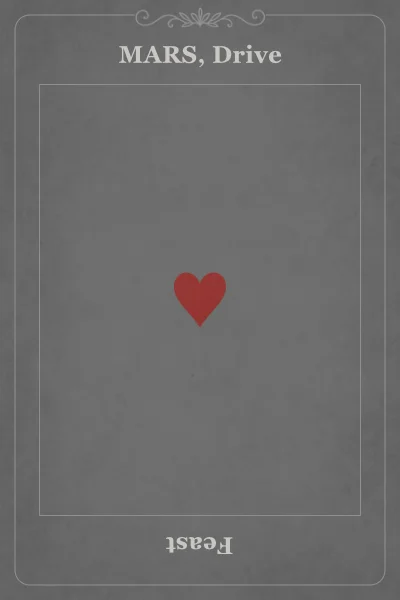
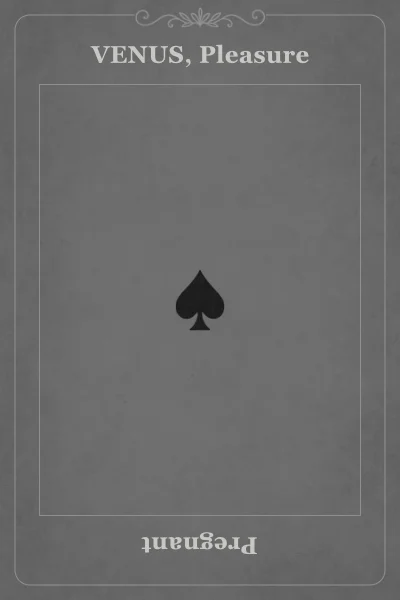
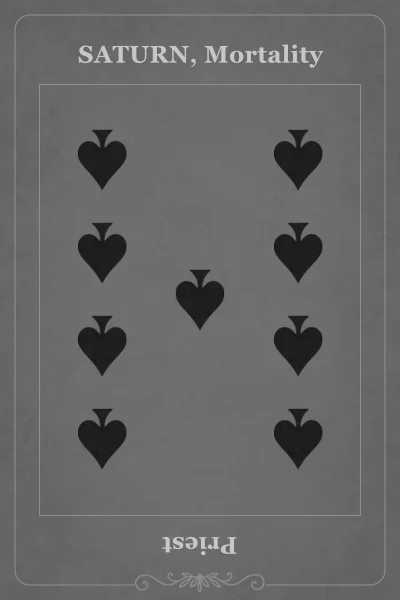
The unnumbered ♥A, ♠A and ♠9 cards are marked with planetary names: MARS, VENUS and SATURN. So ♥A MARS, ♠A VENUS and ♠9 SATURN are often treated as the planetary cards.
In many traditional decks, these cards may show only the planet name instead of a separate keyword. That can look intimidating at first, but it is not a trapdoor to scholarly doom. You can read them through the conventional associations of Mars, Venus and Saturn.
Some modern decks add keywords that express the character of each planet more directly.
Reading a Single Card
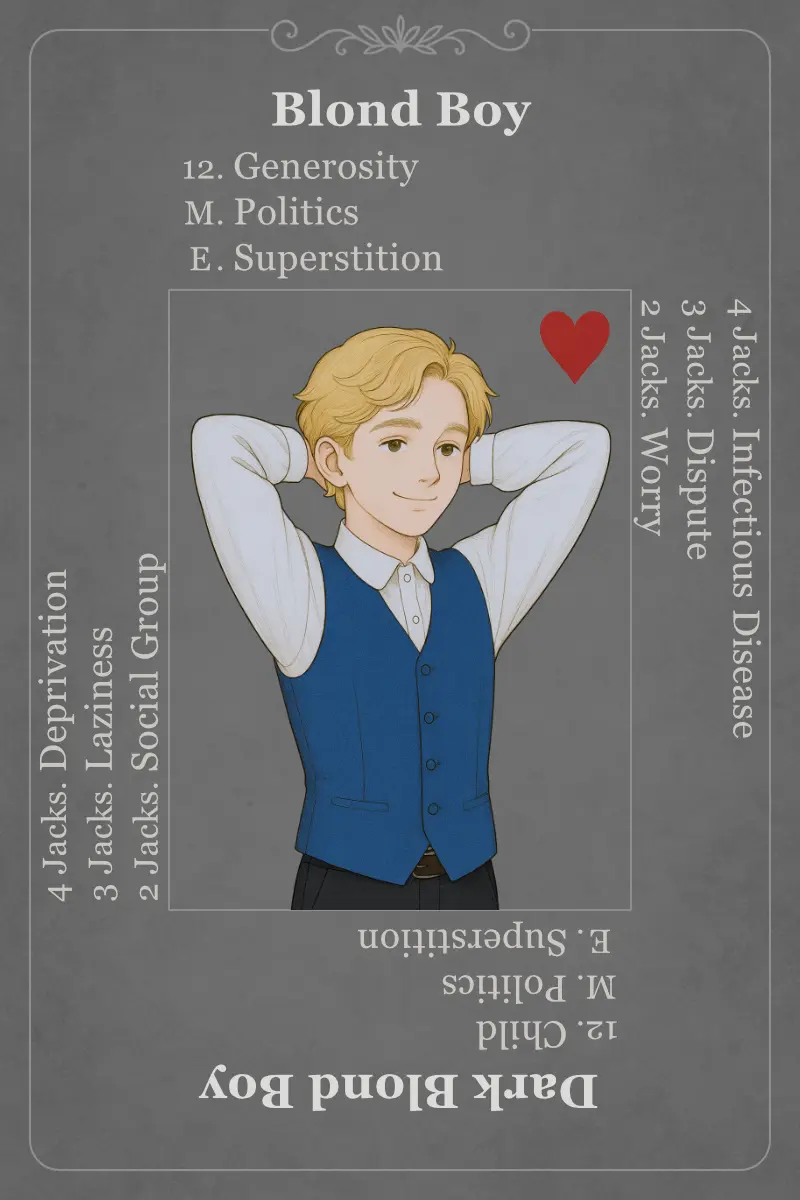
Most Petit Etteilla decks print the keywords directly on the cards. At first, the card face can look busy, almost aggressively informative. But once you get used to it, this is actually the kindest part of the system. The keywords are already there. You do not have to memorize the whole deck before you begin.
Upright and Reversed
Petit Etteilla needs reversed cards. This is not optional decoration. Upright and reversed meanings are often not simple positive and negative versions of each other. In many cases, they are separate keyword sets.
So do not treat every reversed keyword as automatically negative. Read the keyword assigned to the actual direction of the card. Upright means upright. Reversed means reversed. The card has already done enough work by having two tiny dictionaries printed on it.
Primary and Secondary Keywords
The primary keyword works almost like the card name. But that does not mean the secondary keyword is less important.
In fact, sometimes the primary keyword is so name-like that the secondary keyword gives you the more useful reading clue. Instead of asking which one is “more important,” choose the keyword that fits the question, or read the two keywords together when they naturally support the same context.
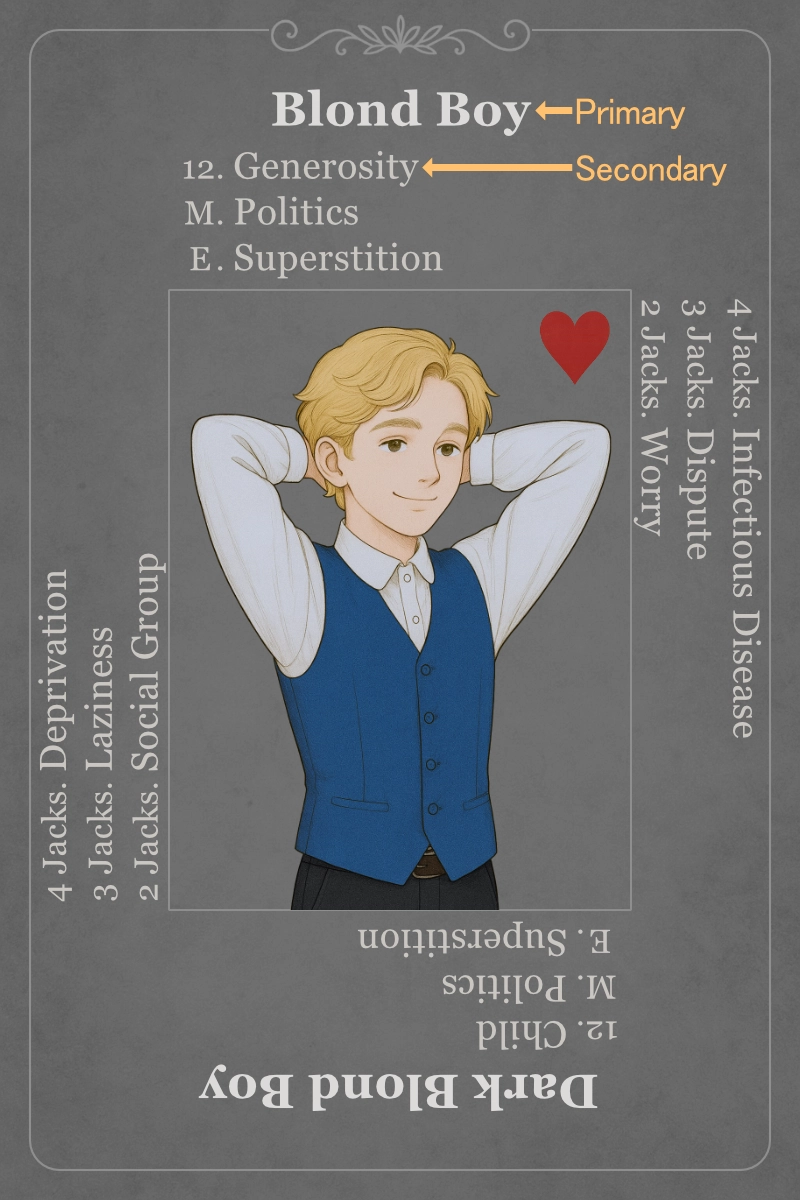
Person Cards
Some primary keywords describe a person by appearance, such as Blond Boy or Brown Haired Girl. I call these person cards.
Older reading methods sometimes matched these cards to people with similar physical features. I do not recommend relying on that today. Real people are not sorted into personality types by hair color. Shocking news, apparently.
It is more useful to read these cards as roles, social positions, temperaments or relational functions within the spread. Ask what kind of person, attitude or influence the card is bringing into the flow, rather than trying to identify someone by appearance alone.
Suit, Rank and Number
The suit can give you a general tone or atmosphere. The rank matters when you look for multiple keywords. The card number matters when you look for meeting keywords.
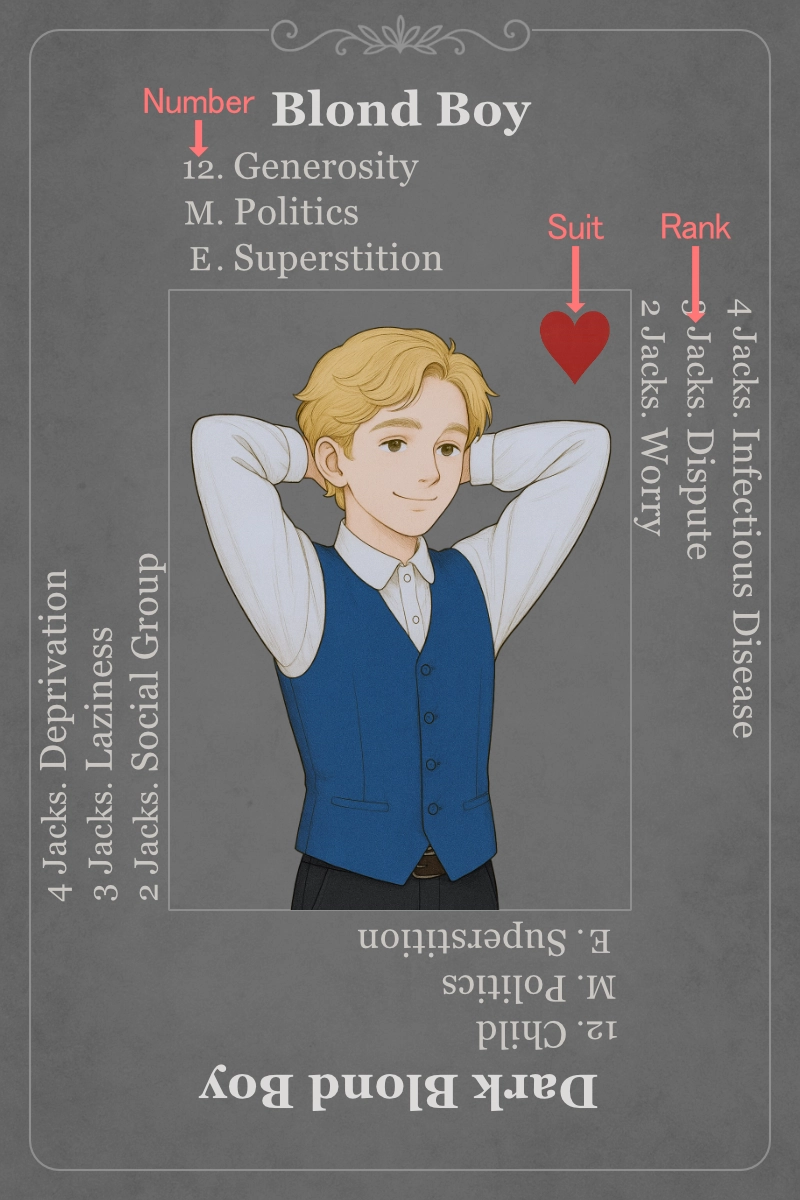
Rank: used for multiple keywords
Number: used for meeting keywords
When Cards Meet Other Cards
The most interesting part of Petit Etteilla is that the cards do not work only as separate units. They form little teams inside a spread. When certain conditions are met, cards can create extra keywords: meeting keywords, Etteilla keywords and multiple keywords.
These extra keywords can be surprisingly strong. They slide into an ordinary reading and suddenly change the pressure of the whole story. Like a tiny sniper hiding in a deck of cards, because apparently one layer of meaning was not enough for humanity.
Meeting Keywords
Meeting keywords are based on card numbers. Two numbered cards whose numbers add up to 31 share a meeting keyword. If both cards appear in the same spread, you may add their shared meeting keyword to the reading.
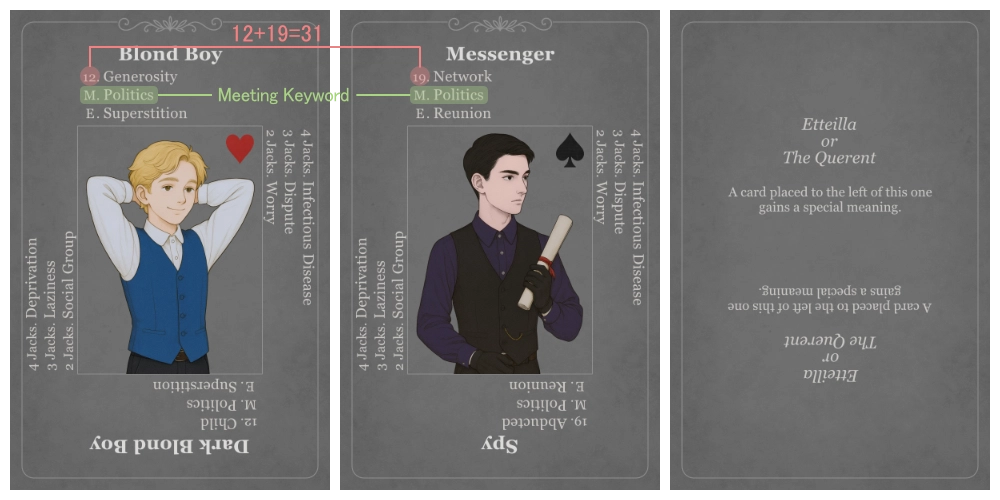
Meeting keywords apply regardless of whether the cards are upright or reversed. The planetary cards discussed earlier have no card numbers, so they do not produce meeting keywords.
Etteilla Keywords
The Etteilla card is the special card unique to Petit Etteilla. Some readers treat it as the querent or significator. In practical reading, I usually pay more attention to whether it activates an Etteilla keyword.
In a spread, the card immediately following the Etteilla card can use its Etteilla keyword. Petit Etteilla spreads are read from right to left, so the card placed to the left of the Etteilla card is the “next” card.
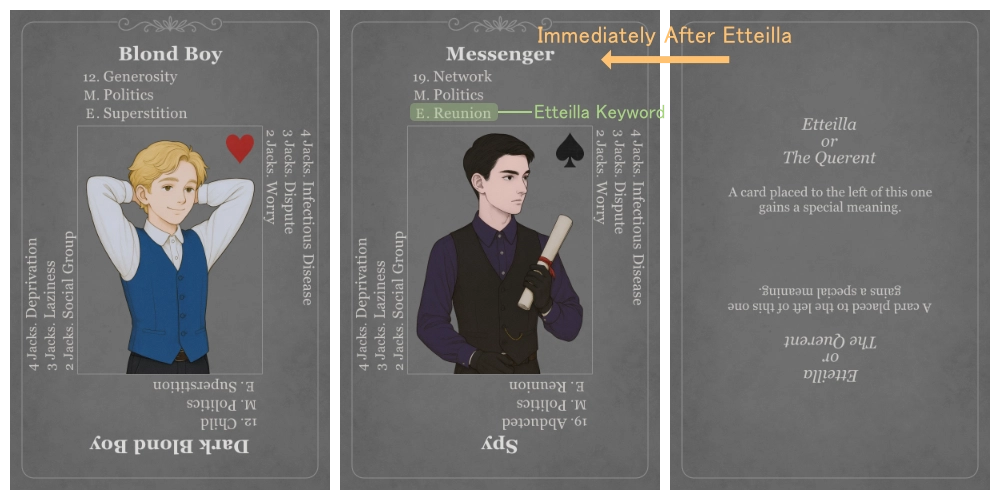
Etteilla keywords also apply regardless of upright or reversed direction. If the Etteilla card appears as the last card in the spread, there is no following card, so no Etteilla keyword is created.
Multiple Keywords
Multiple keywords are based on rank: King, Queen, Jack, Ace, 10, 9, 8 and 7. When cards of the same rank appear in the same direction, and when there are 2, 3 or 4 of them, you may add the multiple keyword for that rank and count.
Two conditions matter: the cards must have the same rank, and they must face the same direction. If two cards have the same rank but one is upright and the other is reversed, the multiple keyword does not apply.
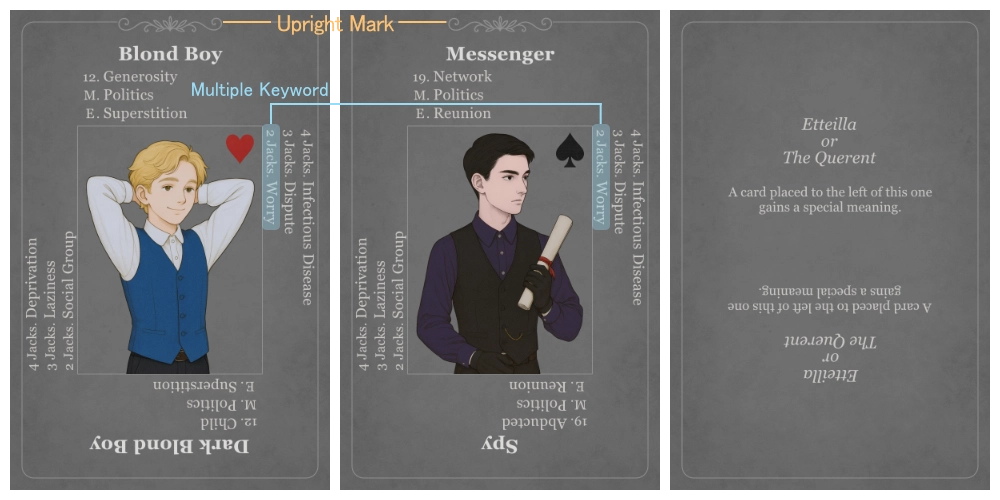
When a card is upright, the upright multiple keyword is on the right side of the card. When a card is reversed, the reversed multiple keyword is also on the right side of the card. So once you know the card direction, you look to the right for the multiple keyword.
pright and Reversed: A Simple Summary
| Type | REV | How to Read |
|---|---|---|
| Primary | Yes | Use the keyword that matches the card direction. |
| Secondary | Yes | Like the primary keyword, use the keyword that matches the card direction. |
| Meeting | No | Only the card numbers matter. The two numbers must add up to 31. |
| Etteilla | No | Only check whether the card immediately follows the Etteilla card. |
| Multiple | Yes | The cards must share the same rank and the same direction. |
Primary keywords, secondary keywords and multiple keywords require you to check upright or reversed direction. Meeting keywords and Etteilla keywords do not. For those, only the condition matters.
Card Flow
From Right to Left
Petit Etteilla usually uses simple line spreads of 2, 3, 4 or 5 cards. The important point is that the flow begins at the right end and moves left.
Another distinctive feature is that the positions are not fixed as past, present and future. Instead of forcing every card into a rigid position label, you read the natural logic and story created by the card flow.
Tense Lives in the Question
A reading can still have a sense of time. It just does not need a fixed timeline printed under every card. The main tense often comes from the question itself.
“What will happen from now on?” is read with a future focus. “Why did that happen back then?” is read with a past focus. “What is going on right now?” is read with a present focus.
Time Cards
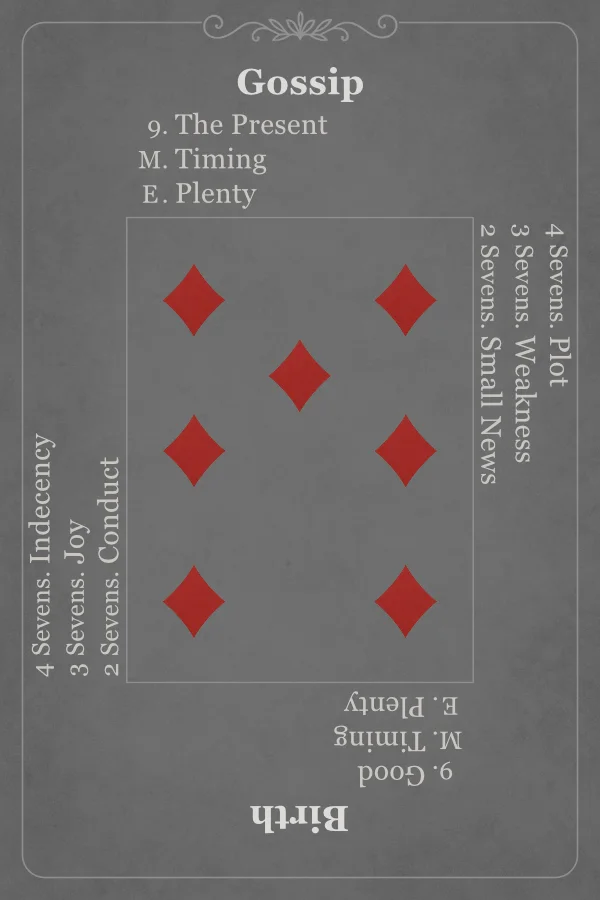
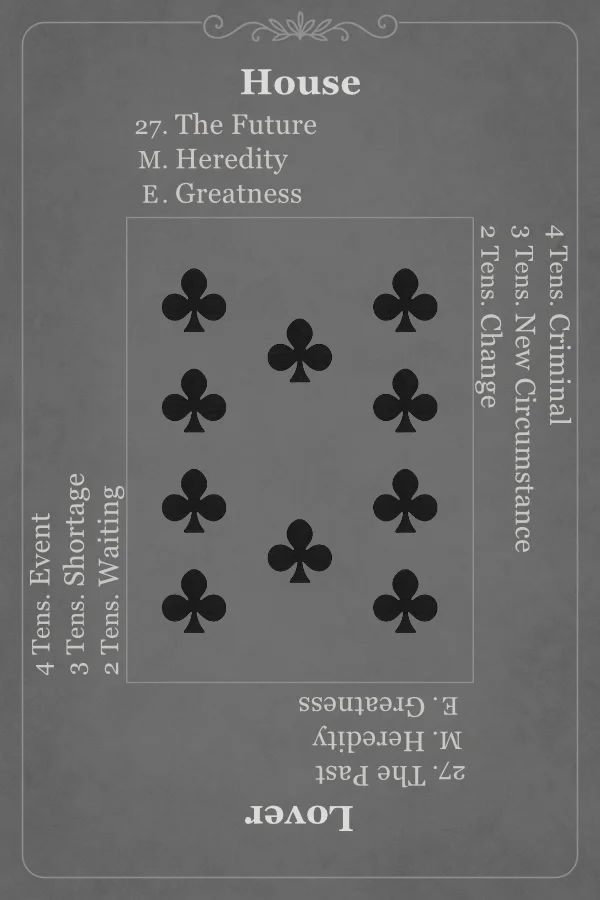
Sometimes the cards themselves bring time into the reading. A card may include a keyword such as past, present or future. When a time card appears, you can use the tense indicated by that card as an extra layer.
When You Actually Read
Petit Etteilla cards can look crowded. A single spread may contain primary and secondary keywords, meeting keywords, Etteilla keywords and multiple keywords.
But if you look closely, each keyword is usually just one or two words. Those words are not final answers. They are starting points.
Petit Etteilla reading is not about copying every keyword literally into a sentence. It is about taking the keywords that fit the question and extending them into a natural context. Start from the keyword, then let the question and the card flow decide how far that meaning should expand.
So What Matters Most?
The most important thing is natural storytelling. Instead of analyzing each card in isolation, read the line of cards as one connected movement.
If you try too hard to be perfectly analytical, Petit Etteilla can become difficult fast. This card has that keyword, that card has this rule, this number makes that combination, and then congratulations, you have built a spreadsheet with anxiety. Meanwhile, the actual reading flow quietly escapes through the back door.
Stay with the main thing: what the question is really asking, which time point it is focused on, and how the card flow receives that question and develops it.
2. Read the card flow as a natural context, not as isolated fragments.
Discard Keywords That Do Not Fit
Once the cards are laid out, the upright primary and secondary keywords usually catch the eye first. If the Etteilla card appears, it is also easy to notice the Etteilla keyword on the card immediately after it.
In the beginning, that is enough. A reading does not become “complete” just because you have chased down every possible keyword.
Earlier, I described meeting, Etteilla and multiple keywords as snipers because they can suddenly crack or redirect the context created by the primary and secondary keywords.
If that crack creates a useful insight, weave it into the reading. If it makes the flow unnatural or forced, leave it aside. You already choose among primary and secondary keywords according to context. The same principle applies here.
Do not get stuck trying to calculate every meeting keyword or multiple keyword, and do not force an unrelated keyword into the story just because it appeared. Petit Etteilla is not a game of collecting the highest number of keywords.
Keep the keywords that fit the question and the card flow. Let the rest go lightly.
If You Still Feel Uneasy
If you dislike the idea of missing a keyword, take out a piece of paper. Write down all the primary, secondary, meeting, Etteilla and multiple keywords that appear in the spread. Then choose the ones that fit the question and the flow.
It is a little tedious, but it works. The point is not to force every keyword into the interpretation. Seeing all the keywords at once makes it easier to decide which ones should stay and which ones should be left out.
Reading Example
Question
My account was suspended even though I did nothing wrong. If I contact customer support, will they restore it?
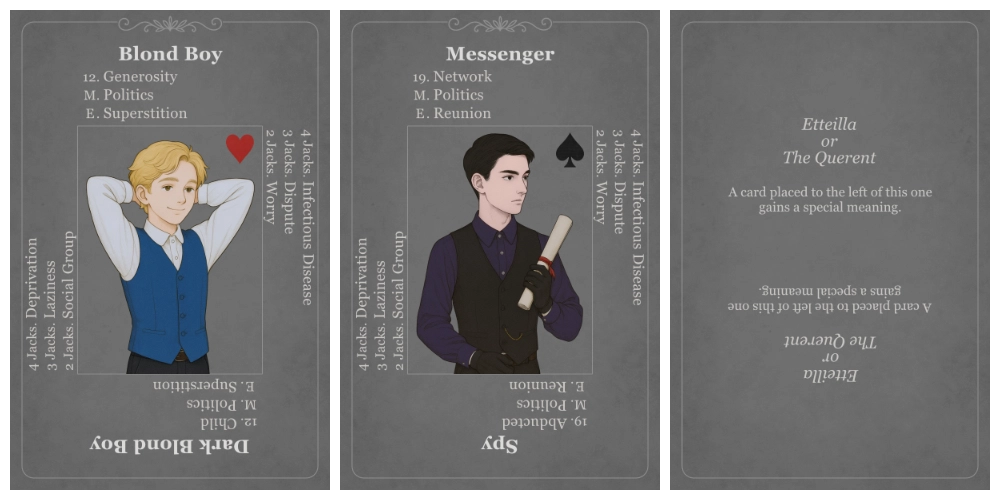
Three-Card Spread: E-♠J-♥J
2. [♠J] Messenger / communication / network / connection [Etteilla] Reunion / Remarriage
3. [♥J] Generosity / Ease [Meeting] Politics [Multiple] Worry / Anxiety
Checking the Extra Keywords
First, ♠J Messenger appears immediately after the Etteilla card. That means we can add the Etteilla keyword of ♠J: Reunion / Remarriage. In this question, it is not about romantic reunion. It can naturally expand into the idea of regaining access to an account that was cut off.
Next, ♠J is card number 19 and ♥J Blond Boy is card number 12. Since 19 + 12 = 31, these two cards activate their shared meeting keyword. Their meeting keyword is Politics.
Here, Politics does not need to mean party politics. It can expand into rules, procedures, internal judgment, support policy or the discretion of the person handling the case. That fits the question about customer support.
Finally, ♠J and ♥J are both Jacks and they appear in the same direction, so a multiple keyword can also apply. The multiple keyword for two Jacks is Worry / Anxiety.
Weaving the Keywords
The overall flow is clear: contact is made, connection is restored, and something that was interrupted becomes connected again. The presence of generosity and ease suggests that customer support may not be hostile or harsh.
But Politics and Worry appear together, so the process may not feel instantly clean or simple. There may be rules and procedures to wait through. During that process, the querent may feel more anxious than the actual situation requires.
Final Reading
Contacting customer support looks likely to help restore access to the account. The response does not look especially hostile, and the spread does not suggest that the querent is being treated as malicious. Still, the process may move through rules and internal procedures, so anxiety during the wait is understandable.