Five Card Horseshoe
Like any other tarot spread, the Horseshoe comes in several versions.
The one SCHEMAcards' AI is built on is the Five Card Horseshoe that's popular here in Korea.
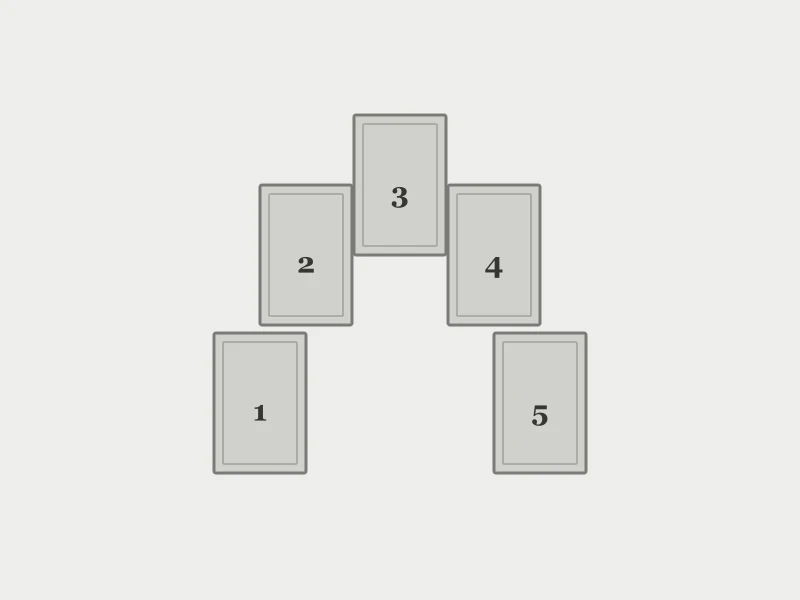
2. Expectations
3. The Unexpected
4. Near Future
5. Far Future
Card 2 (Expectations) and Card 3 (The Unexpected) closely resemble "What You Expect" and "What You Don't Expect" from traditional playing-card cartomancy — but since the five-card Horseshoe's origins are unclear, that's only a guess, not a confirmed lineage.
Here in Korea there's been a small debate over whether to read them as "what you want / what you don't want" or as "what you expect / what you don't expect."
I went with the latter, labeling them "What you imagine will happen / What might surprise you."
On top of that, I read Card 5 not as "Far Future" but as "Recollection from the Far Future."
All of it reflects my own personal take.
Personally, I see the cards in a spread not as a row of separate photographs, but as a video — they push and pull against each other.
That way there are no gaps between the cards, and instead of filling those gaps with imagination, each card holds its coherence with the others exactly as it is.
In other words, the cards should connect with "and" or "so" — never with "but."
Once they do, the cards in charge of the future stop being prophecies fallen from the sky and become the place where the earlier cards converge. And moving into the near future from "what you expect / what you don't expect" is a more coherent convergence than moving there from "what you want / what you don't want."
From the same angle, "Far Future" reads more naturally not as some distant, far-off day, but as the very next step following the near future.
But the sense of distance the word "far" carries is stronger than you'd think.
Get swept up in it, stretch the gap between the near future and the far future too wide, and a coherence-breaking blank opens up — and the card starts to act as if it were a prophecy.
So instead of "Far Future," I gave it the label "Recollection from the Far Future."
It clears up the misunderstanding the wording invites, and it's designed so that — without fretting over the distance from the near future to the far — you can look back over the earlier cards and close the reading beautifully.
The SCHEMAcards Version
2. What you imagine will happen
3. What might surprise you
4. The near future
5. Recollection from the far future
Card 1 isn't an objective account of an event or incident.
It's the present situation seen through the querent's eyes, and their attitude toward it — so it's subjective.
That's why Card 2, the one that comes right after, is what Card 1 flowered into.
If Card 1 were an objective present, there'd be no guarantee Card 2 had to grow out of it.
But Card 1 is a subjective gaze, and that's what makes it possible to tell Card 2 as something sprouting from it.
What makes this spread special is Card 3.
Like the obstacle card in the Celtic Cross, it's a fairly powerful variable that reflects outside forces.
Set it beside Card 2 and trace the gap between them, and you'll run through the full range of emotion.
When you read Card 4, look at which route it arrived by — Card 2 or Card 3.
Depending on whether it came the way you imagined or turned up from somewhere you didn't expect, the very same card can wear a completely different face.
Card 5, as I mentioned, is the label I changed to fit my own perspective.
It lets you look back calmly over what this matter was — and so, what it became.