What Is the Grouped Line Spread?
In tarot, the Grouped Line Spread is a line spread where none of the cards are given a designed role.
Say "three cards" and most people picture the past / present / future labels, right?
In a Grouped Line Spread, no card carries a label like that.
Its Staying Power
The Grouped Line Spread has taken a lot of scorn over the years.
Among readers who prize spread structure and the role of each card, some have looked at it with contempt; among seasoned readers with years behind them, some have written it off as a beginner's mistake, hardly worth the name.
But through all that humiliation it has stubbornly survived, and over the past few years more and more readers have actually been using it.
Here's how I think about that staying power.
"It's like the word 'ain't' — scolded as wrong for generations, yet so widely spoken that the dictionary finally had to let it in as standard too."
Tarot works with language, builds storytelling, carries meaning from one person to another through words.
If something gets scorned and yet doesn't vanish — if it gets used more, not less — doesn't that mean the Grouped Line Spread was actually a pretty good way of carrying a reading across to the seeker?
Now that it's settled this fully into the world of tarot, I think it's time to stop casting it out as a heretic who broke with tradition, and start asking instead: how do we read it well?
Different Ways to Read It
There's no single fixed way to read a Grouped Line Spread — it varies from reader to reader.
Usually it comes down to about these three.
- Reading it as a flow of narrative or logic, without dividing it by tense
- Taking in the whole picture and letting an image rise from it
I can't judge which of these is right or wrong.
But just as readers are advised to decide up front whether they'll use reversals and how they'll read them, it's good to settle your reading rules for the Grouped Line Spread in advance too.
Otherwise, if you waver mid-reading, unsure which standard you're even reading by, the confidence never quite arrives — and it gets hard to put a period on your own reading.
How SCHEMAcards Reads It
SCHEMAcards' AI treats any 3/4/5-card line spread as a Grouped Line Spread when not a single position label is assigned.
And I've told it to read that spread not as a tense flow, but as a vector flow.
You lay the cards out left to right, take in the whole, and read the vector motion pushing from left to right.
The card on the left comes first; its force flows into the card on its right and, at the same time, pushes that card onward to the next.
Grand vocabulary, I know lol — but the actual interpretation runs on very basic moves.
The Question
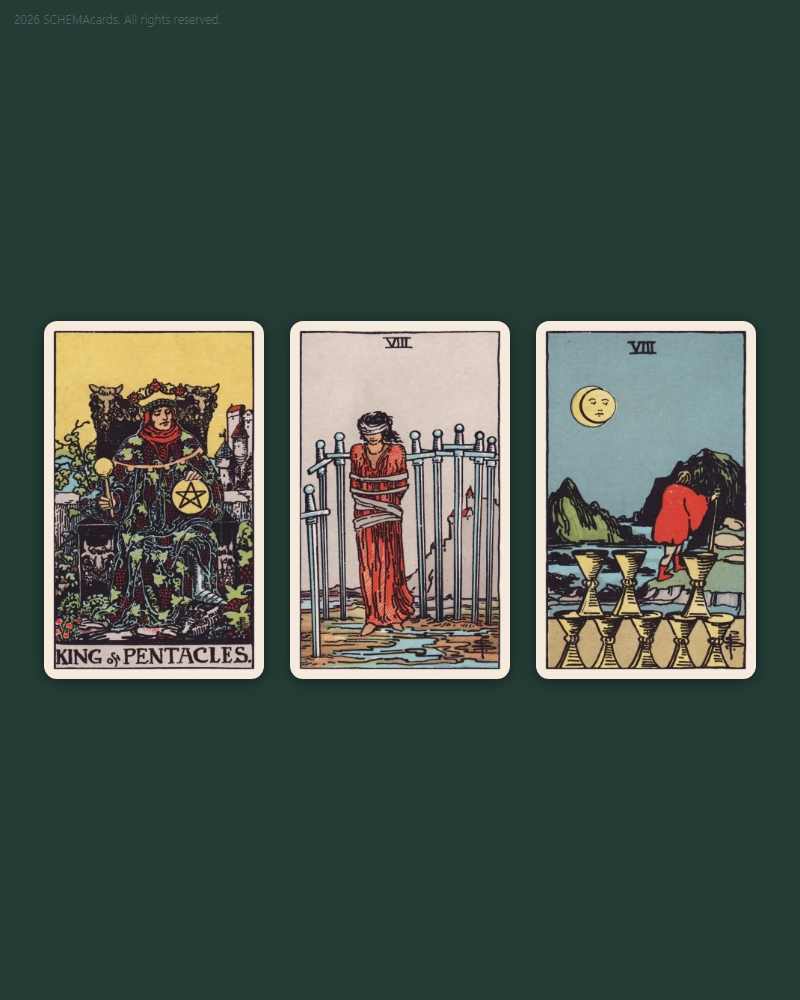
Eight of Swords — limits, bound, can't find a special way out
Eight of Cups — so-so, dull, not to one's liking
Vector Reading
→ (taking the force of the King of Pentacles on the left) No drive means no special move; the only ideas that surface are ones you've heard somewhere before.
→ (taking the force of the Eight of Swords on the left) The common method isn't the road to ruin — it's actually the safe one. But it strikes you as dull, so your eyes don't really land on it.
The Last Card
And on top of this comes my last card rule.
The last card rule means treating the card placed at the very end as this reading's core frame / theme / title — the principle by which the world of this question turns.
That makes this card not the place where the others converge, but the place that governs them all.
In my experience, it felt quite natural to check the governing last card first, then read the rest while testing whether they fit it.
I use this last card rule actively with the Grouped Line Spread, and — as in the Celtic Cross — whenever the last card's role label is the outcome.
Applied to the question from earlier, the Eight of Cups placed last is the core frame of this reading.
You let the Eight of Cups guide you and push the rest of the cards along naturally.
Final Reading
The market is perfectly viable, yet there's no drive to actively compete — and with no drive, nothing special comes to mind beyond the common method.
But the method everyone reaches for is, in fact, proof that it works well enough.
Even if the common method isn't to your liking, as long as there's no sharper move, trying it is the only move left.
The AI Reading
I've given SCHEMAcards' AI model all sorts of instructions through the prompt, but honestly, it doesn't seem to follow them all that smoothly.
For one thing, it isn't using the usual approach of reciting the drawn cards one by one; for another, cost being what it is, I'm running a budget model.
And even setting those technical reasons aside, I think AI catching up to humans is still a long way off.
An AI that knows the querent well ends up over-projecting them onto the cards, giving a reading that's predictable and dull; an AI that doesn't know the querent projects the human average instead of the querent, which can sometimes sound to them like a story about someone else.
The most dramatic moment in a card reading comes when you make an unexpected discovery inside the obvious data of the question and the querent.
That precarious tightrope walk — tying together what I know and what I didn't — is still something human instinct and intuition do overwhelmingly better.