Famous, but Tricky
If you work with tarot, the Celtic Cross is one spread you simply can't not know.
But it's also notorious—almost everyone has, at least once, knelt in defeat in front of all ten of its cards.
And beyond the sheer number of cards, there's another serious problem.
Several versions exist for how the cards are laid out and read, which means two people working under the same name "Celtic Cross" might actually be using different versions.
Picture two people arguing while pointing at the past card and the future card in completely opposite spots—it'd be absurd.
The Early Version
The person who made the Celtic Cross famous was Arthur Edward Waite, of the Rider-Waite deck.
In his book The Pictorial Key to the Tarot, Waite introduced the Celtic Cross as a divination method of the ancient Celts.
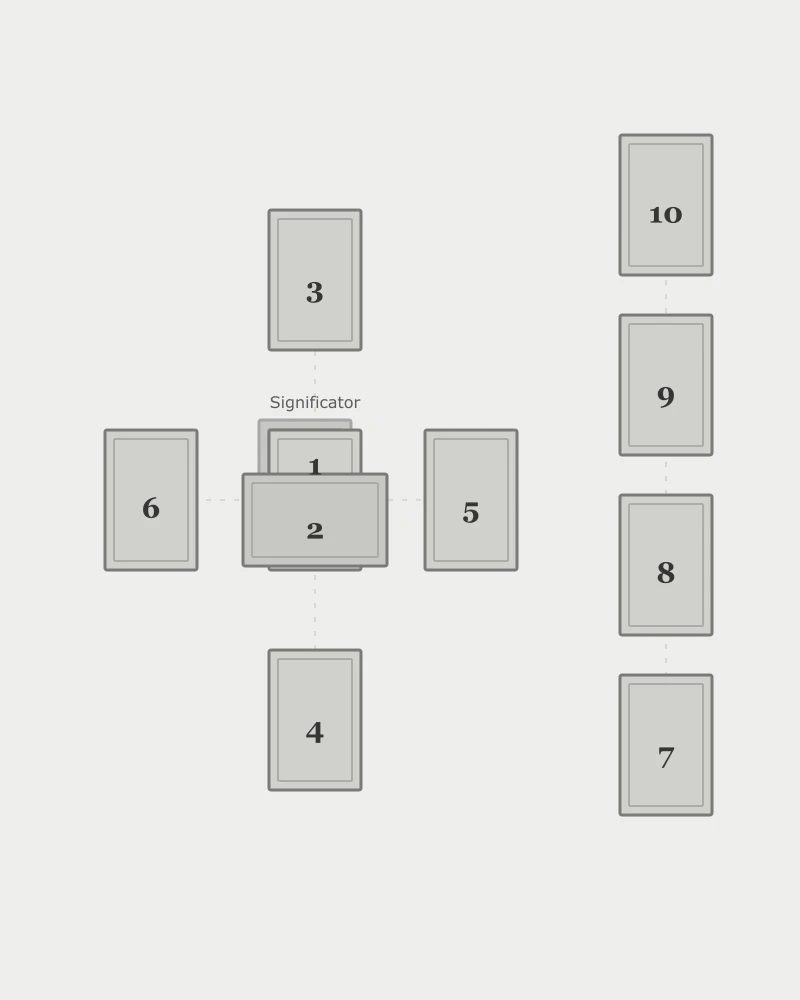
1. That covers him
2. What crosses him
3. What crowns him
4. What is beneath him
5. What is behind him
6. What is before him
7. Himself
8. His house
9. His hopes or fears
10. What will come
Compared with the version of the Celtic Cross popular today, the Significator card stands out, doesn't it?
What sets Waite's Celtic Cross apart is that you start by laying down a single card chosen as the Significator—based on the querent's physical appearance, or on the theme of the question.
On top of that, cards 1 and 2 are placed overlapping the Significator (covering it), card 3 goes above it, and card 4 goes below it.
And then card 5 is placed behind the gaze of the figure drawn on the Significator card, while card 6 is placed in front of that figure's gaze—a treatment based on the "direction of the gaze."
The Variant Versions
As time went on, the Celtic Cross kept undergoing small changes.
Maybe the transformation had already begun the moment Waite borrowed what was originally a divination method of the ancient Celts.
After Waite, it was Eden Gray's rearrangement of cards 3/4/5/6 that caused a real stir.
In her book The Tarot Revealed, Eden Gray laid out cards 3/4/5/6 by rotating them clockwise—beneath, behind (left), crowns (top), before (right). Because this made it easy to build a chronological narrative and easy to memorize, it spread widely and became something like the new standard for the Celtic Cross.
It did draw criticism—the cyclical arrangement starting from the bottom doesn't fit Waite's philosophy, and it lost the "gaze" symbolism of the Golden Dawn tradition—but its sheer convenience ended up overwhelming all of that.
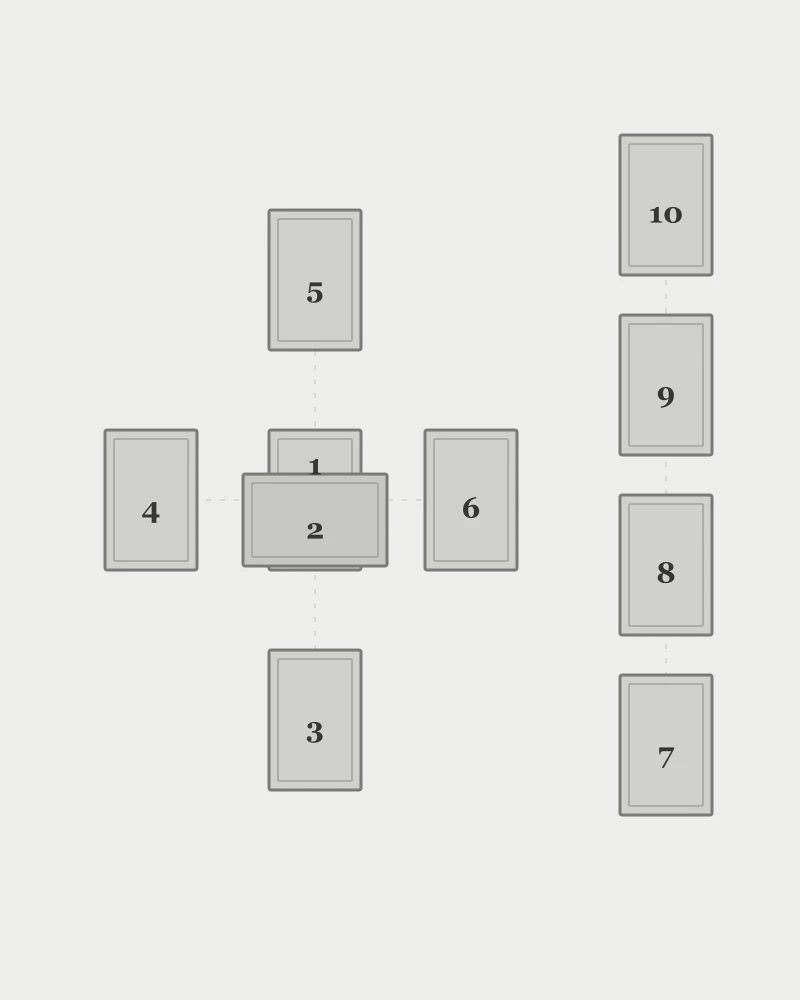
As I mentioned, in Waite's Celtic Cross the placement of cards 5 and 6 is decided by the Significator's "gaze," right?
But in Eden Gray's 3/4/5/6 arrangement, cards 3/4/5/6 get fixed positions, so that judgment call is no longer needed.
And as the era turned away from racial and appearance-based discrimination, it was a natural step that the part of the Significator's selection criteria matching the querent's looks came under fire.
So for these and other reasons, people omitted the Significator more and more often, until in the end it vanished from the Celtic Cross and faded into history.
The version popular in Korea today removes the Significator from Waite's Celtic Cross and keeps only the 3/4/5/6 card placement in Eden Gray's style.
The SCHEMAcards Version
SCHEMAcards' AI mostly follows how each card is used in the version of the Celtic Cross popular in Korea today, but it makes one exception: it applies my own Last Card rule to card 10.
2. The Obstacle ― what the querent has overlooked or lacks; what stands in their way
3. Unconscious Motive/Undercurrent ― an inner drive the querent can neither notice nor explain on their own
4. The Recent Past ― the lingering trace of the querent's most recent experience
5. Conscious Aim/Expectation ― a clear intention grounded in the querent's predictions
6. The Near Future ― the likely next development along the querent's trajectory
7. Self-Image ― the person the querent believes themselves to be
8. Environment ― the people and surroundings around the querent, the pressure from outside
9. Hopes/Fears ― what the querent wishes for and what they avoid
10. The Core Frame/Theme/Title ― the overarching theme that governs every card. The largest principle keeping this matter in motion. The subject or title that fits this matter.
The Last Card
The Last Card rule means treating the very last card placed as the core frame/theme/title of the reading—the principle by which the world of this question turns.
When you do that, this card stops being the place where the rest of the cards converge, and instead becomes the place that governs them all.
In my experience, it makes for better storytelling to check the governing last card first, and then read the remaining cards while testing whether they fit it.
I use this last card rule actively with the Grouped Line Spread, and — as in the Celtic Cross — whenever the last card's role label is the outcome.
In the Celtic Cross especially, it pairs well with Eden Gray's chronological 3/4/5/6 placement.
Once you take the last card as your marker, you can get a fairly convincing reading just by reading the rest of the cards in order under that marker's guidance.
You don't have to measure every card against the last card—it's enough to lean your interpretation toward it only for the cards you're unsure about.
That's because the Celtic Cross has so many cards that the ones to the sides and above and below are already giving you plenty of hints.
The Last Card rule is there to help your interpretation, not to shackle it.
The Question

Ten of Swords ― resignation, scorched earth, a game completely over
Three of Cups ― friendship, celebration, nothing too serious
Knight of Wands ― travel, exploration, adventure
The Fool ― a fresh start, taking action, foolish, reckless
Four of Wands ― a warm welcome, settling in, a milestone
Five of Swords ― winning and losing, taking it all, ruthless
Two of Cups ― empathy, union
Temperance ― optimization, fine-tuning, correction, letting go
Nine of Swords ― needless worry, rational fear, nightmares
Cards to Check Against the Last Card
I worry that switching to Claude might actually make the project worse.
→ Checked against the Nine of Swords: the math is leaning toward the bad outcome before any evidence is in.
I'm planning to hand more and more over to Claude—was that really a good call?
→ Checked against the Nine of Swords: I've already started using it, so there's no point in needless agonizing. Nothing bad looks likely to happen, so I just need to settle in well.
Strictly on the technical side, is this really the best choice?
→ Checked against the Nine of Swords: of course some areas come out ahead and others behind. So let's not stress ourselves out weighing it all too carefully.
Card Combinations
Once you've built your storytelling by reading the cards in order while checking them against the last card, the next thing you can do is compare the picture more closely through combinations of cards.
Let me list a few that I know.
[ 1 + 2 ] a comparison between the present situation the querent subjectively perceives and the present situation objectively at work
[ 3 + 5 ] a comparison of the gap between the querent's unconscious and conscious
[ 7 + 8 ] a comparison between the querent's self-image and outside pressure